

Filed Under: Uncategorized
A little while ago I found myself taking a city bus to the Canada Day celebrations here in Calgary. And what a wonderfully fun day of celebration it was. But as my little family and I waited for the bus to go home that evening, there was a bit of a delay and I found myself getting frustrated and admittedly even a little cranky at having to wait. We had walked many miles during the day, and damn it, I wanted to get home, relax a little, and watch a little mindless TV.
We were sitting in a bus shelter and a light, warm, summer rain was starting to gently fall — I started to realise that feeling upset or angry about the slow bus wasn’t really productive, positive or really much fun. Instead of getting crotchetier, I made a quick decision, I decided to take a few deep cleansing breaths and chose to just be present in the moment and just immerse myself in the bus waiting experience.
I started to mindfully notice and appreciate all the small wonderful details I was missing when I was cranky. The warm rain was falling and leaving beautiful abstract patterns on the glass and the rain smelled so wonderfully fresh and clean. Outside of the bus shelter, a couple of teenage sweethearts giggled, laughed and held hands as they ran in out of the rain. The rain gently pattered onto the wet concrete and the car tires made wonderful swooshing sounds as they drove by. Thunder rumbled gently in the background and I let my mind wander back to the innocence and wonder of my childhood memories of storms and my grandparents warm and loving house. In just a few minutes of acceptance and immersion in the moment, I noticed I wasn’t really feeling crotchety anymore. In fact, I was feeling calm contented and even relaxed!
Looking back, making the choice to accept the circumstance I was in; immerse myself in that moment and step away from feeling frustrated was a really good one that day for me. Through acceptance and making that positive choice to just be in that moment, I shifted from feeling frustrated to feeling quite relaxed and contented. It was really about acceptance and choice. Once I accepted that the bus arrives when it arrives, not necessarily when I think it should arrive, I started on the path away from my negative emotions. By choosing to immerse myself in the moment and actually making an effort to truly see and appreciate my surroundings I became one with the situation and just lived in that moment as it was, rather than expecting it to be perfect. The acceptance allowed me to enjoy the beauty of that experience
Zen Buddhist Monk Tich Nhat Hahn talks about a similar experience about the mundane chore of doing the dishes:
Thirty years ago, when I was still a novice at Tu Hieu Pagoda, washing the dishes was hardly a pleasant task. During the Season of Retreat when all the monks returned to the monastery, two novices had to do all the cooking and wash the dishes for sometimes well over one hundred monks.
There was no soap. We had only ashes, rice husks, and coconut husks, and that was all. Cleaning such a high stack of bowls was a chore, especially during the winter when the water was freezing cold. Then you had to heat up a big pot of water before you could do any scrubbing.
Nowadays one stands in a kitchen equipped with liquid soap, special scrubpads, and even running hot water which makes it all the more agreeable. It is easier to enjoy washing the dishes now. Anyone can wash them in a hurry, then sit down and enjoy a cup of tea afterwards. I can see a machine for washing clothes, although I wash my own things out by hand, but a dishwashing machine is going just a little too far!
While washing the dishes one should only be washing the dishes, which means that while washing the dishes one should be completely aware of the fact that one is washing the dishes.
At first glance, that might seem a little silly: why put so much stress on a simple thing? But that’s precisely the point. The fact that I am standing there and washing these bowls is a wondrous reality. I’m being completely myself, following my breath, conscious of my presence and conscious of my thoughts and actions. There’s no way I can be tossed around mindlessly like a bottle slapped here and there on the waves.
. . . There are two ways to wash the dishes. The first is to wash the dishes in order to have clean dishes and the second is to wash the dishes in order to wash the dishes. . . .
If while washing the dishes, we think only of the cup of tea that awaits us, thus hurrying to get the dishes out of the way as if they were a nuisance, then we are not “washing the dishes to wash the dishes.” What’s more, we are not alive during the time we are washing the dishes.
In fact we are completely incapable of realizing the miracle of life while standing at the sink. If we can’t wash the dishes, the chances are we won’t be able to drink our tea either. While drinking the cup of tea, we will only be thinking of other things, barely aware of the cup in our hands. Thus we are sucked away into the future – and we are incapable of actually living one minute of life.
Being mindfully aware can be applied to any of life’s routines, waiting for the bus, washing the dishes, driving to work, or even waiting in a line up at the DMV. (Although even Buddha himself probably would struggle to be mindful and present at the DMV).
So how do you be more present and aware when you’re in what feels like a frustrating place or situation?
Here are some tips to help you wait for the bus or wash the dishes:
Recognise your own impatience or frustration.
The first step to stepping away from negative emotions to a more content and a mindfully calm place is to realise that they are happening and that they are affecting us. How often do we find ourselves frowning or scowling and feeling negative and then suddenly realise what a waste it really is to feel that way? Once we realise we’re feeling impatience or anger or frustration we can understand ourselves better and then start to do what it takes to change those negative emotions to more positive or even neutral ones.
The real power we have over any environment is in making the choice to be present, aware and immersed in the experience. We can’t choose our feelings and emotions — but if they are negative we can choose how long we hang on to them — we can choose to not ruminate on them making them bigger than they are.
What can you control?
In waiting for the bus, you absolutely cannot control when the bus gets there, but you can control how you choose to perceive the situation and use that time. Use that time to do some deep breathing or other meditation exercises like noticing all of the sensory input you’re receiving — open yourself to the experience, what can you see around you, smell, hear, feel?
Be curious and look for wonder!
Use the waiting time to look around you and be curious about your world. Look at things with fresh eyes. Look for the wonder around you, the beautiful sunny sky, an interesting looking or acting person, a cute giggling toddler, an elderly couple holding hands, a bright and colourful ad or billboard, pretty flowers or a big beautiful tree, maybe the diversity of all of the interesting and colourful people around you. Don’t judge things just explore them and accept them as they are.
Acceptance is key.
Again, the bus comes when it comes. Being frustrated will just make it seem like it takes even longer! Take those deep cleansing breaths and just accept that’s really just the nature of buses!
Find gratitude.
Use the time while you’re waiting to mindfully make a gratitude list. What are you grateful for? Your family, your job, your shiny new shoes, your recent achievements, your friends, that the bus will be half empty, that the sun is shining, that it’s Friday, that your family’s health is good, that you have a vacation coming up? Gratitude can really help us gain perspective and pull ourselves out of the rabbit hole of negative emotions.
Making the choice to be mindfully aware of the moment you’re in without allowing negative thoughts to interfere can be a wonderful way to lessen the daily stress in our lives — being present can lead to living a more relaxed and harmonious existence.
So the next time the bus is late, just slow down, appreciate the moment and be more curious about the world around you.
If you’re interested in exploring these ideas a little more: Here’s a link to another great blog about learning how to appreciate each moment! http://on-being-real.com/on-being-real/getting-quiet

References
A Lifetime of Peace: Essential Writings by and about Thich Nhat Hanh —By Nhất Hạnh (Thích.) Da Capo Press; 1 edition (Sept. 25 2003)

As a Psychologist in Calgary, journaling is a strategy that I highly recommend to many of my clients. It can be a great method for them to get in touch with their core emotions; a powerful way to explore and understand their thought patterns and really come to a deeper sense of self-understanding. I also use journaling in my own life and I really feel it’s a great strategy that can really help anyone who tries it to understand themselves better. I have also seen this strategy help many clients lessen the impact of anxiety and depression on their lives. I have also seen many clients use journaling as a great strategy to help them work out problems and make better decisions in their lives.
Journaling can be a very simple strategy in which we write down our feelings and thoughts on a regular basis, looking for patterns and insights that may help us improve our situation and live a better life. Journaling is a great way to capture and explore the emotions and thoughts that surround the events of our daily lives. It allows us to capture and explore our habits, actions and reactions to our world — it can help us really illuminate and interpret what’s going on in our lives and decide on better, more productive ways of thinking and acting. It allows us to evaluate our thinking, our emotions, and our behaviour in a way we wouldn’t normally do. Usually, in life, we go cruising along on autopilot and don’t make the effort to look at our thoughts, feelings and actions — journaling allows us to actually explore if our thoughts and feelings are really helping make our lives better.
Journaling allows us to take the time to be truly introspective and creates the opportunity for us to look at how we are acting and reacting in our world and perhaps find better ways of doing so. Journaling is really one of the best ways to advance our personal growth and emotional development. By getting your thoughts out of your head and putting them down on paper, you can really gain insights you may otherwise never see.
Though regularly writing in a journal seems a simple thing to do — when you’re depressed or anxious it really may not be that easy. Writing about our feelings and emotions takes energy and sometimes too, it can be uncomfortable or even painful to write about the negative feelings and thoughts we have when we are anxious or depressed. But it might be worth it to try. Journaling is a proven strategy for helping people improve the symptoms of anxiety and depression. Almost always, part of the mechanism that maintains anxiety and depression is a brain that looks at the world through a negative and skewed filter. A depressed and anxious brain often selectively focuses on negative thoughts and opinions and disregards any neutral or even positive alternative thoughts. Journaling for anxiety-depression can really help sufferers explore their thoughts and feelings, help them feel better and look at their world in a more accurate and less negative way. If you do decide to try journaling be sure you check with your mental health professional and if it makes you feel worse — don’t do it.
Here’s some more information on journaling as a strategy for anxiety/depression:
http://www.depressiontoolkit.org/takecare/journaling.asp
https://www.psychologytoday.com/blog/shyness-is-nice/201404/how-keep-thought-diary-combat-anxiety
Journaling is also a great way to help us get some perspective and solve our problems. How often do we really sit down and really look at a problem from a few different perspectives? We usually just think about it a little bit and then go with our gut and make a decision. That’s great sometimes, as our intuition and hunches can often help us make good decisions — but many problems might be better solved by actually looking at them more in depth. Journaling allows us to slow down, look at different perspectives and can really help us make a make a measured and reasoned decision. Writing things down allows us to better see all of the sides of a problem — writing can give us a clarity we may not otherwise see.
We can really only concentrate our mind’s power on the small parts of any problem we’re trying to solve. Although our brains are powerful problem-solving machines, they are still quite limited in their ability to look at all the parts of any complicated problem we may be facing. For example, close your eyes and picture the house you live in — notice you can really only see one view of it at a time. Can you see the front and the back at the same time? Not so easy. The same thing happens with a problem we’re trying to solve — we’re only really able to see a little piece of the problem at one time. Journaling gives us the ability to really look at all of the possible angles and perspectives of a particular problem. A powerful decision-making tool indeed.
So, how do you get started — what should you write down in your journal?
A good place is to start with buying a journal that appeals to you, maybe it has funny cats on it, or it’s a particular design or colour, or maybe it’s a beautiful leather journal that appeals to you. Get something that appeals to you and makes you want to write in it!
One brand that is a bit spendy, but very well made and attractive, comes from the Moleskine brand: http://www.moleskine.com/
You can also journal electronically on your laptop or even try a Smartphone App like this free one at https://itunes.apple.com/us/app/stream-journal-easy-journaling/id972439087?mt=8
So what exactly should you be writing down? There is no right or wrong way to do this.
Here are some great ideas to start with.

Try to look candidly and objectively at the thoughts and emotions you’ve written about. Be frank with yourself, but be careful to not let the journal become a place where you beat yourself up or where you harm your self-esteem.
Sometimes it can help to just let a stream of consciousness flow and go with it!
Find a peaceful time and place to journal every day — make it a part of your self-care regimen.
Remember there is no right or wrong way.
Here is a link to a great website with many more great ideas on how to start journaling:
https://journaltherapy.com/journal-cafe-3/journal-course/
Keep your journal private — it’s important that you should feel free to share absolutely anything in your journal. Do whatever you feel is prudent to protect your journal and ensure that others aren’t able to access your private thoughts.
So give it a try for a few weeks and see if this method can help you reduce stress, solve life’s problems and find some new perspectives and ideas to improve your world.

“Forces beyond your control can take away everything you possess except one thing, your freedom to choose how you will respond to the situation.” Viktor Frankl
We all have problems, issues, trials and tribulations in our lives. Everyone. The reality is that no one leads a charmed life without some kind of problems. Depression/anxiety, marriage problems, difficult teenagers, taking care of aged parents, financial problems, stress at work, health problems. No one gets a free pass. This is the human condition. So how do we start to make things better? How do we start to make a change when we feel that it’s hopeless?
“Optimism is the faith that leads to achievement. Nothing can be done without hope and confidence”. Helen Keller
Are you a hopeful person? Do you wake in the morning with a sense of optimism and positive expectations? Take a look at your environment at home and work. Do you have coworkers, friends and family around you that are hopeful and positive? Do you feel connected to them in positive ways? Do you feel a sense that you are capable and effective in your daily life? Do you feel that you are acting from a place of safety and security or do you feel that you are constantly reacting?
Most importantly, ask yourself: Are you willing to work on those areas in which you are less than hopeful? Are you willing to work on yourself and begin changing your attitudes? Your unique outlook on your own life is the key to strengthening your emotional core, sense of optimism and building resiliency in your life. So how do we start to do that?
One of the most important things that can help us start to make change is to take a deep breath and accept our present circumstances, especially if it feels that they really suck right now. I don’t mean you should stop trying and just accept the suckiness. Just that maybe, sometimes we spend so much time fighting and railing against our negative present circumstance, that we don’t use our energy wisely. We spend our energy whinging and complaining about how bad things are and how much it sucks rather than looking at how to move forward and gain some traction in making our world better. To start the process of change we have to accept that our world is truly full of bittersweet paradox. There will always be good and bad in our life but we always have a choice in how we choose to look at our world and what we do to try and make things better.
When we are no longer able to change a situation – we are challenged to change ourselves. Viktor Frankl
The first step in building hope, and starting to change, is asking yourself: What do you want your life to look like? What’s going right and what’s going wrong? To really build a sense of hope, we have to set our sights on goals and a future that’s realistic and achievable.
Ask yourself, what do you really, really want to change in your life that would really make things better? A good place to start is to ask yourself the Miracle Question, a thought experiment taken from Solution Focused Therapy.
If tonight while you’re sleeping, a miracle occurred, and your life improved (in realistic ways), what would look differently in the morning and how exactly would it look differently? Describe this new and improved world in detail. Although obviously our world usually doesn’t have miracles asking yourself this question is a great way to stop focussing on the problem and start looking at the possibility of a world where the problem has been dealt with and your life has changed and improved.
Once you’ve really figured out what you want to change, a good next step to do that is to set some SMART goals. SMART goals come from management guru Peter Drucker. SMART goals are specific, measurable, achievable, relevant/realistic and time-sensitive.
Perhaps the most important part of setting goals is actually making the effort to set them! You can’t hit a target if you don’t have a target to aim at!
One of the foundational building blocks of change is starting with the belief that change is possible in your life. Without this firm belief in place, it’s really hard to move forward.
You need to have a firm belief, with little doubt that the achievement of change is a possibility. Decide for yourself that being hopeful and starting change are possible and realistic. Visualise and even fantasise about what your life will be like after you make this change. How exactly will it be better? How will it feel? What will improve?
Part of developing a “firm belief” that we can change is through using positive language and self-talk. I’m sure most of you have heard the term “self-talk” or the term “inner voice”, or even the intimidating sounding “critical inner voice” or “negative self-talk”.
But what exactly is self-talk or the inner voice? Well, it appears to be a form of natural and automatic “inner dialogue” that pops in and out our conscious thinking. It takes the form of thoughts, expressions, suggestions, ideas and concepts that transmit themselves into our “consciousness” and into our awareness. It is often this “little voice” that guides our day-to-day behaviours and tells us we should “call our mom, catch up on our paperwork or try harder at some task”. No, the little voice does not mean you are crazy. Pretty much everyone has a little inner or self-talking voice to some degree.
One of the best ways to build a sense of hope and optimism is to challenge any negative self-talk/thoughts rather than avoiding or ignoring them. Is your “inner voice” telling you that you’re not good enough, or that you’re goals are just too hard and unachievable? Here is an article on how to change and challenge your inner voice if you find it’s really overly negative and critical: https://roberthammel.com/shut-up-quieting-the-critical-inner-voice/
Remember that Buddha said:
All that we are is the result of what we have thought. The mind is everything. What we think we become.
Take into consideration all the things you’ve already done in your life. Remember and chronicle your earlier achievements and successes, make a list or journal about them. What challenges have you overcome before? We all have a list of success and achievement that we can look to help build our confidence that we can indeed change. In fact, the reality is that one of the constants in human life is change! Evolution shows that we are constantly evolving adapting and changing… it’s “natural” to change and improve and “unnatural” to stay stuck in a negative rut!
Who in your life fills you with that sense of hope and positive energy? Are the people you hang around with helping you feel more hopeful and positive or are they draining your energy with whiny negative attitudes? Water seeks its own level, so make an effort to be around people that support your vision for a better future and want what’s best for you.
Fostering hope and starting to change requires the courage to take that first step. Close your eyes, pinch your nose and jump!!! Take that first step in the right direction and be committed to yourself and the process of change.
Think about why you’re doing this, focus your attention on the goals you’ve made, and fantasise about how it’ll feel and what your life will look like when you complete this important change into your life. We’ve all had the experience of wanting to start an exercise or diet “next week” — when next week just keeps getting put off, and it never actually happens. Make the commitment to begin — and then follow through. Don’t expect a miracle and that everything will change overnight. Becoming more optimistic and positive requires you to check on and even “adjust” your attitude every day and maybe even a few times a day!! Realise it’s a process and it will take work and time! Sometimes change requires us to take two step forwards and one step back.
Once you choose hope, anything’s possible.~ Christopher Reeve.
What charges your battery and makes you feel inspired? Look to your spirituality or faith, to inspirational reading or music. Some people even look to nature and being outside or even to running, hiking or other physical activity that makes them feel inspired. Look for things that “light your fire”. Really try to care for yourself and perform “self-care”, here’s a link to some self-care ideas: https://roberthammel.com/7-steps-to-emotional-self-care/
Chronicle your thoughts and feelings in a journal. Journaling can be a great way to help you understand why you have been feeling lost and start to change to a more positive and hopeful way of being. Choose a suitable place to sit down and just start writing about your thoughts, attitudes and feelings; what you are thinking, or whatever seems important to write about. You can also use your journal as a way to document the progress toward your goals. Journaling is also a great way to keep track of how far you’ve come and how much you’ve accomplished in the journey to completing your goal of change. Buy a new journal that’s appealing to you; a pretty cover, leather covered, nice paper or whatever appeals to your sense of aesthetic. Here is a great place for journaling ideas https://journaltherapy.com/journal-cafe-3/journal-course/
Finally, we have to realise and accept that sometimes in life, we have to be in an uncomfortable place to move forward in positive ways. Feeling a bit distressed often just means that we are breaking out our “comfort zone”, that we are growing and we are learning to live our life in a better way! Making the effort to change can seemingly require a Herculean effort at first, but that’s why it’s worth it!!! There really is some truth in the tired cliché, “No pain, no gain”. Making a change often takes effort and time, and sadly there are usually are no shortcuts. Change your self-talk and tell yourself that even though it may be difficult and hard at first; it’s worth it, you’re growing towards a better life, that it’s only temporary, and that it will get easier!
Good luck and Godspeed in starting that change in your life! Also, remember that seeing a Psychologist for therapy can also really support you in making changes in your life!
There is no medicine like hope, no incentive so great, and no tonic so powerful as expectation of something tomorrow. Orison Swett Marden
This blog is not intended as medical advice, treatment or diagnosis and should in no way replace consultation with a mental health or medical professional.
References
Drucker PF. The Practice of Management. New York: Harper & Rowe, Publishers; 1954

There are many people in our world that deal with chronic pain of many different types. Pain is a daily part of life for them. The pain can be from migraines or other types of headaches, arthritis, fibromyalgia, old sports or car accident injuries, lower back pain, cancer pain, multiple sclerosis, shingles, psoriasis, and many other causes.
According to the World Health Organisation study in primary care settings across the world, approximately one-fifth of all primary care patients suffer from persistent debilitating pain, and they are four times more likely to have co-morbid anxiety or depression than pain-free primary care patients.
And even with all of the advancements in modern medicine and all of the pharmaceutical options for pain management, only 58% of chronic pain is managed with prescription options; leaving many people suffering with little relief in sight.
Interestingly, people with only depression and not chronic pain often still have symptoms of headaches, chronic body aches, and pain. There is really an intricate and complicated connection between depression and chronic pain. Depression can worsen how we perceive any existing chronic pain and it’s well known that suffering persistent or severe pain can cause us to feel depression. This can lead to a circumstance where pain and depression create a vicious cycle where pain worsens the symptoms of depression, and the resulting depression can then worsen the feelings of pain.
Why do pain and depression often create this vicious cycle? A recent and quite excellent review of the research looks at the complicated relationship between pain and depression. According to researchers Han and Pae (2015) many psychological factors are at play regarding pain and depression. Most importantly they identified the following important connections between chronic pain and depression. When people display these behaviours and act in these particular ways it can make their chronic pain and their depression worse.
Pessimism and negative thinking: can affect a pain sufferer by increasing their perceived pain levels and also decrease the ability to manage it. Whereas actively trying to think more positively and optimistically can actually lessen pain, improve mood and help us to manage the pain more effectively. This isn’t just about thinking positive thoughts. It’s about gaining acceptance of the actual situation over time and “making the best of it”. Accepting that this is what life has given and “it is what it is” without putting a negative or limiting value judgement on it. It’s about concentrating on what we have and what we can do rather than a negative focus on what we’ve lost or what we can’t do.
Fear-avoidance beliefs: which have to do with a person avoiding doing things in their life because they fear that the activity will make the pain worse, whereas, in fact it may actually make them feel better! Pain can make people feel and act overly fearful and they then avoid movement and activity so as to not cause themselves more pain — this in turn leads to disengagement from life’s meaningful activities, causing further disability and depression. A perfect example is physical exercise. Physical exercise approved by your doctor can often improve pain levels and improve mood, but people often have an unfounded fear that it will make pain worse, when in fact is may improve their mood and help actually lower pain levels.
Perceived control of the pain: People with chronic pain and depression often feel helpless and hopeless about their situation because they don’t feel they have any level of control over their pain. This can actually increase the pain they feel. When in fact, they may actually do have some control through proactively making a regular effort in changing how they think! or by taking control of their treatment they may gain some control. This is also about maybe realising that through developing better coping mechanisms like using exercise, meditation or actively being aware of and changing their “self-talk” and self-beliefs they can gain some control and reduce pain levels.
Perceived social support: is about how we actually recognise how much support we are getting from other people, including things such as help with practical things like transportation and help with cleaning or cooking when pain levels are high. It can also include emotional support, like having others listen to us, show empathy, show interest in our lives and feelings. The more social support a person with pain believes they have, the less isolated and alone they feel and this can actually affect their perceptions of levels of pain.
This review of the research showed that these psychological factors play a very crucial role in how someone with chronic pain thinks about and feels regarding their pain and life circumstances. These factors can play into the vicious cycle that can often make chronic pain much worse than it has to be.
In a nutshell… when it comes to managing pain the research shows that…
How a person chooses to “think” about their pain can actually affect and lower the levels of pain they feel and can even reduce their feelings of depression! This is huge for someone with pain! By learning how to think about their pain and life differently… they can actually feel less pain and improve their mood!
Most importantly Han and Pae (2015) found that a key factor in dealing with pain and depression was how much the person participated in the maladaptive and unproductive way of thinking called “catastrophizing“.
In psychology, catastrophizing is seen as a “faulty thinking pattern” where we fall into firmly believing “the worst case scenario” about any situation. When we are catastrophizing, we act “as if” that catastrophic outcome has already occurred creating much helplessness and hopelessness.
Catastrophization with chronic pain is largely about magnifying the pain felt, where thinking and concentration is centred on the feelings of helplessness, hopelessness, where we centre much thinking on how the pain feels and all of the negative ways it can limit and affect our lives. People with the combination of pain and depression often magnify and “over-feel” their feelings of pain and helplessness.
People who catastrophize tend to assume the worst possible outcome will always occur even when it might not.
It can also be about feeling totally sorry for ourselves… that the absolute “worst thing in the world” has happened to us and there is no way out!
Catastrophizing leaves us with a deeply hopeless, sad and negative mood. Research shows if a person ‘catastrophizes” their pain they may even experience higher pain levels and can even be more incapacitated than someone who doesn’t catastrophize and keeps a more positive view of their situation.
If you deal with chronic pain how can you start to feel better?
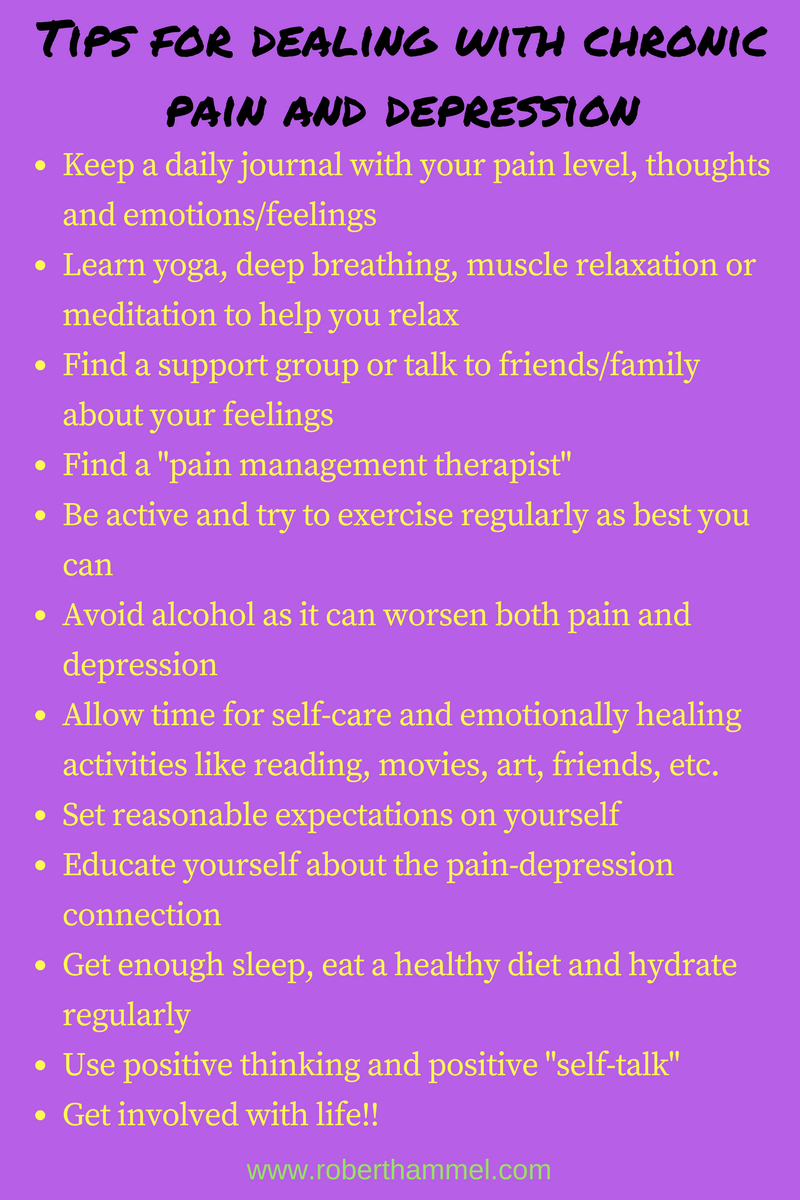
A good place to start feeling better is to try to make sure you are getting enough sleep, eating well, and hydrating. Avoid alcohol and junk foods as they can both affect our pain levels and worsen our moods.
Keep a daily journal with all of your thoughts emotions and feelings. Be honest with yourself and use it a place to let out the negativity, stress and worry.
Being kind to yourself with good “emotional self-care” can also be a good place to start.
Try to get re-engaged with your life. Get out as much as you are able, connect with your friends and family, join a club, join a team, volunteer, find a new hobby. Do something to connect you to life!
Get active. Exercise as much as you can as approved as by your doctor. Physical exercise an excellent way to improve pain levels and to improve our mood. There is a good deal of research showing that even a small amount of regular movement and exercise can help mediate depression and lower pain.
Find a support group. If you can’t access or find one in your community — look for one online, like the ones on Facebook Groups
Lower your stress levels. Too much stress can exacerbate both pain and depression. Try yoga, meditation, progressive muscle relaxation, deep breathing or meditation strategies. Some research also shows that acupuncture can also be helpful as a way to reduce stress and pain.
Think constructively and try to use positive thinking. By focusing on the bigger picture you can make a big difference in your perceived pain level. For example, instead of considering yourself powerless and thinking that you absolutely cannot deal with the pain, remind yourself that even though you have pain, you’ve been dealing with it already and you’ve done pretty good so far! Accepting your situation for what it is can be a huge step to moving forward emotionally. You have chronic pain… so what? Use positive self-talk to tell yourself… it is what it is, and you can, and will deal with it. Positive thinking and distracting ourselves with other activities can lessen the pain and improve our mood.
If you find yourself catastrophizing and feeling that the worst case scenario has already happened because of your chronic pain? Try to write down and then really look at and challenge those negative thoughts.
Use more balanced and positive self-talk to honestly look at your life and concentrate on what is positive and what you have to be grateful for rather than the “woe is me” attitude that chronic pain can lead us into.
Don’t let the pain define you!! You are more than your pain.
Finally, going to therapy/counselling with a therapist knowledgeable about depression and pain management can be an excellent way to manage your depression and pain.
This blog is not intended as medical advice, treatment or diagnosis and should in no way replace consultation with a mental health or medical professional.


